Vitamin D Test Price in Delhi or, Vitamin D Total -25 Hydroxy Test In Delhi for a blood tests:
- Typical range ₹800-₹2000
- Common discounted price online ₹900–₹1400
Labs like Max Lab, Metropolis Healthcare, Dr. Lal PathLabs, Thyrocare and often fluctuate within this band depending on demand and bundled offers.
But the variation isn’t random.
Vitamin D testing is still priced higher than routine panels because it’s a specialized assay. So unlike HbA1c, you won’t usually see it drop to ₹300–₹400 unless it’s heavily bundled.
A small observation here.
A lot of people test Vitamin D only after symptoms—fatigue, body aches, low mood.
But by then, levels are often significantly low.
A patient in her early 30s—corporate job, minimal sun exposure—came in mainly for hair fall. Vitamin D was 11 ng/mL.
We weren’t even looking for it initially.
That happens more often than you’d expect.
Vitamin D inside Full Body Checkups
This is where things get a bit uneven.
Many full body checkups do NOT include Vitamin D Test Price in basic packages.
So:
- ₹999 package → usually doesn’t include it
- ₹1,500–₹2,500 → sometimes included
- ₹3,000+ → almost always included
This is where people feel misled.
You assume full body means everything. It doesn’t.
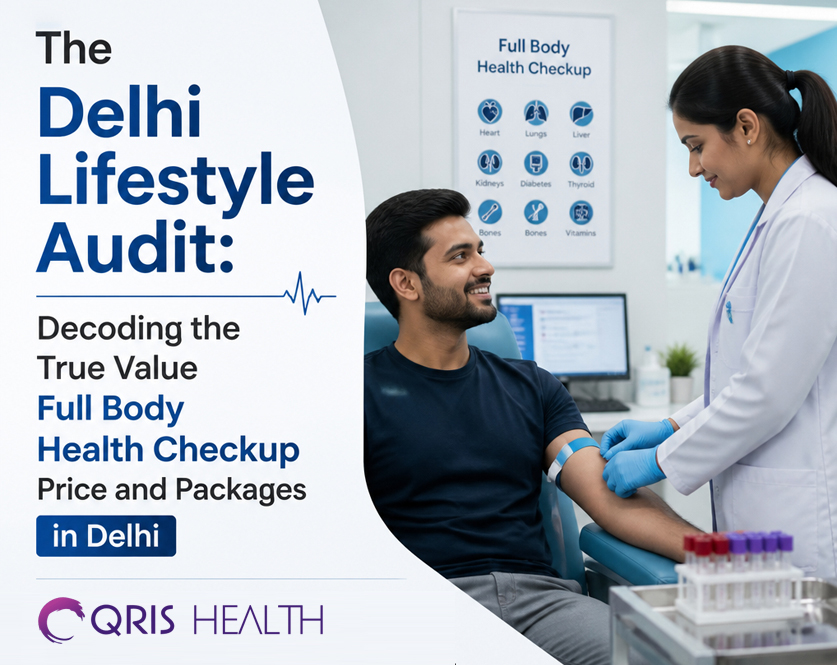
Full Body Checkup Price in Delhi
Let’s place it realistically, without over-formatting it.
Most people fall into one of these three brackets while choosing full body checkup price in Delhi :
Around ₹800–₹1200
Basic screening. Useful, but limited. Good for a quick overview, not much else.
Around ₹1,800–₹2,800
This is where reports start becoming clinically meaningful. HbA1c, thyroid, lipids, liver, kidney—sometimes Vitamin D added.
Above ₹3,000
More detailed panels. Vitamins, inflammation markers, sometimes insulin.
Although—this is where over-testing can creep in.
Not always necessary.
Health Checkup in Delhi — Where Decisions Usually Go Wrong
People tend to anchor on price first then adjust expectations.
It should be the other way around.
A 40-year-old, slightly overweight, low activity, borderline sleep—
If they choose a health checkup in Delhi at ₹900 test panel, it’s not that the test is wrong… it’s just incomplete.
And then six months later, they repeat testing because symptoms persist.
So the initial saving doesn’t really hold.
“Full Body Checkup Near Me” — What Actually Matters
If someone is Searching online for full body checkup near me becomes not the distance now.
Even in Delhi NCR, sample collection is standardized now.
What actually changes your experience?
- Consistency of reporting
- Turnaround time
- Whether abnormal results are interpreted properly
Because most reports come back with values but no context.
And that’s where confusion starts.
One Slightly Overlooked Pattern (Especially in Delhi)
Vitamin D deficiency is extremely common here.
Not just due to diet.
- Indoor work
- Air pollution reducing UV exposure
- Irregular sunlight timing
So even people who “go out daily” can still be deficient.
Which is counterintuitive.
Should You Test Vitamin D Separately?
Sometimes yes.
But not always as a first step.
If you’re already doing a full panel, it makes more sense to include it there.
If symptoms are very specific—persistent fatigue, muscle discomfort, recurrent low mood—then testing Vitamin D earlier can be reasonable.
Although I wouldn’t rely on that alone.
A Slight Reality Check
If you're deciding purely on cost:
- Vitamin D Test Price alone → ₹900–₹1,400
- Basic checkup → ₹800–₹1,200
- Useful combined panel → ₹1,800–₹2,800
Most clinicians quietly prefer the third option…
not because it’s more expensive, but because it reduces blind spots.
There’s also a tendency to chase one abnormal value.
Vitamin D comes low → fix Vitamin D.
HbA1c slightly high → focus only on sugar.
That approach misses patterns.
And health rarely behaves in isolated markers.
Closing Thought
A test is only useful in context.
And sometimes the issue isn’t deficiency itself, it's why it stayed unnoticed for so long.
 Why You Need Vitamin B12_ Energizing Your Life.jpg)